
LamboFoods
A modern restaurant platform designed around menus, ordering, reservations and a strong digital customer experience — built to help restaurants present their brand and accept orders online.
What I built
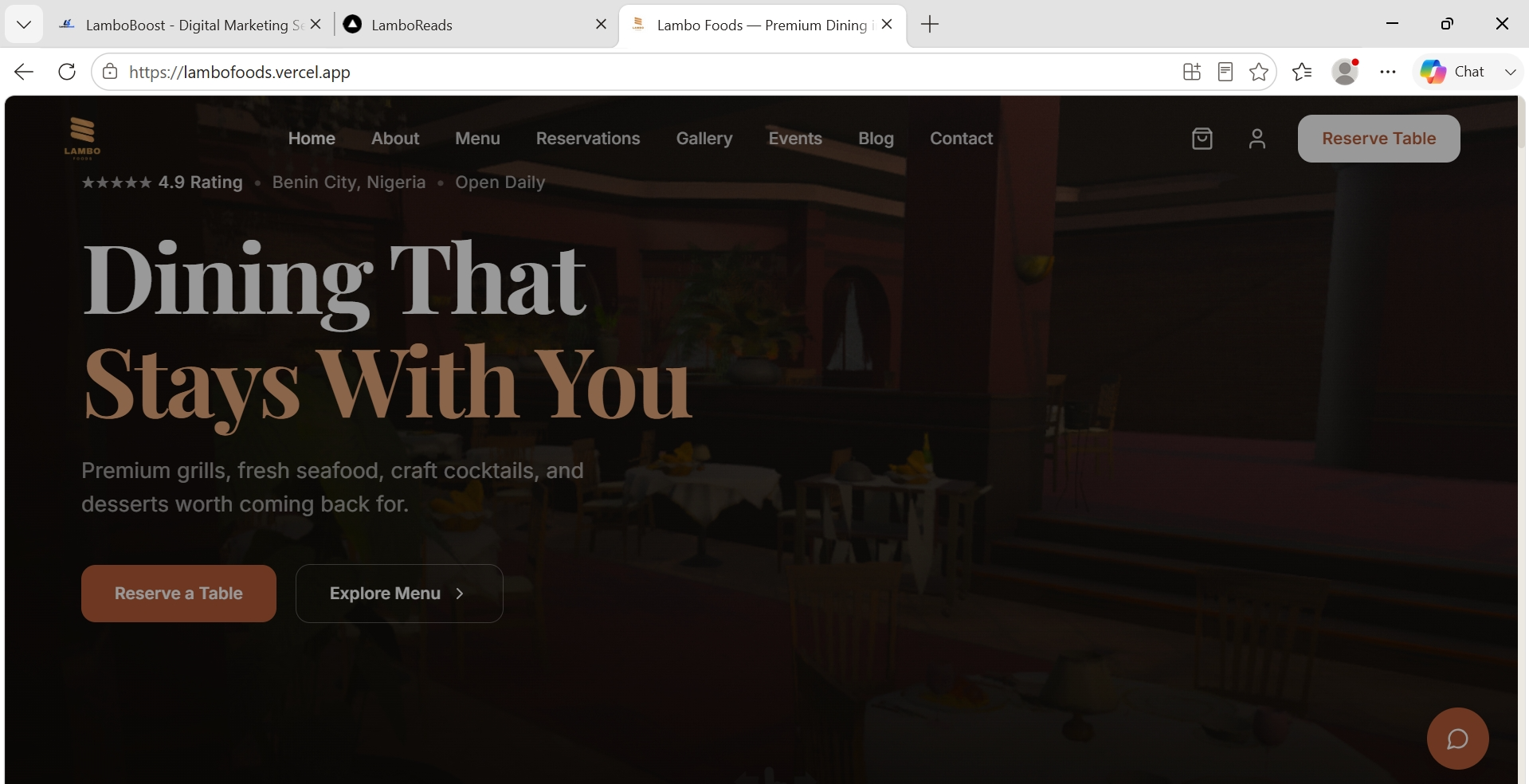
LamboFoods is a restaurant web application that combines menu presentation, food ordering and customer experience into a single platform. It was designed to show what a modern restaurant website can look like when it's built with the same care as a consumer product.
The platform includes a browsable menu with categories and pricing, a visual food presentation layer, an ordering flow, and a reservation system. The entire experience is responsive — designed to work well on phones where most restaurant browsing actually happens.
I built the full stack: the frontend interface, the backend API routes, the database schema for menu items and orders, and the admin tools for managing content.
The problem I was solving
Restaurant websites in Nigeria often fall into two categories: basic social media pages or expensive custom builds that are hard to update. Neither option gives restaurants a professional, ownable digital presence that they can control.
The challenge was building a platform that looks premium, handles real menu data, supports ordering and reservations, and can be maintained without a developer for every small change. The interface needed to work on mobile first — since that's where most food discovery happens — while still looking polished on desktop.
How I built it
I used Next.js with the App Router for server-side rendering of menu pages and static generation for the marketing pages. TypeScript provided type safety across the entire codebase. Supabase handled the database, authentication and file storage for food images.
Frontend
Next.js with responsive CSS Grid layouts. Menu pages are server-rendered for SEO. The ordering interface uses client-side state management for cart functionality with real-time price calculation.
Database
Supabase PostgreSQL stores menu items, categories, orders and reservation data. The schema supports multiple restaurants with separate menu configurations.
Media
Food images are stored in Supabase Storage with responsive image delivery. Cover images and menu photos are optimized for fast loading on mobile connections.
Mobile-first
The entire interface was designed mobile-first. Menu browsing, ordering and reservations all work smoothly on phones, with the layout adapting for larger screens.
What the application does
Menu Presentation
Browsable menu with categories, pricing, descriptions and food photography. Items are organized for quick scanning and easy ordering.
Online Ordering
Add items to a cart, review your order, and submit it directly through the platform. The ordering flow is designed to be fast and frictionless.
Reservations
Customers can book tables directly through the website, selecting date, time and party size. The reservation system handles availability and confirmation.
Restaurant Branding
The platform is designed to showcase a restaurant's brand — with hero sections, food photography and a visual identity that goes beyond a basic menu listing.
Responsive Design
Every page works across phone, tablet and desktop. The menu grid, ordering interface and reservation form all adapt to the screen size.
Tech stack
Only technologies actually used in this project.
Takeaways from this project
Mobile-first changes the design process
Designing for phones first forced me to think about information hierarchy differently. Menu items, prices and order buttons had to be immediately accessible without scrolling.
Cart state needs careful architecture
Building a shopping cart that persists across page navigation, handles quantity changes correctly and calculates totals in real-time required thoughtful state management.
Food photography drives engagement
The visual presentation of food items has a direct impact on how users interact with the menu. Investing in proper image display — aspect ratios, loading states, hover effects — made a measurable difference.
Want to build something similar?
If you have a project in mind, let's discuss what you want to build.